
|
"As long as man has a car, he can do anything and go anywhere. That is the
boast of the infant automobile industry. All right! We ask this question: Is
there anyone willing to travel this summer from Peking to Paris by
automobile?"
"We're making it up as we go along."
In less than 24 hours, the international cast of motorists will start their vintage automobiles and drive down the congested boulevards of the Chinese capital toward the Great Wall.
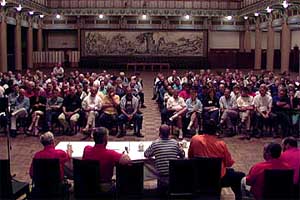 Drivers attend their final pre-race briefing. However, during the long orientation week in Beijing, it has become increasingly apparent that not all of the cars will make it to Paris. After towing more than one automobile from the shipping docks near Beijing, race marshals are betting that most of the entrants will never reach the Eiffel Tower. The mood of the drivers has darkened considerably this week. Each day drivers return to rally headquarters at the Beijing Hotel covered with sweat and oil after spending hours tinkering with their engines and packing and repacking their cars. Concerned about weight, many are mailing back heavy boxes of lotions and unnecessary trinkets. Ninety years of progress and pavement technology may not make this trek from Peking to Paris much less formidable than it was in 1907. Deeming the first rally's course through the Gobi desert a trifle dull, rally organizer Philip Young has devised a 15-day first leg from Peking to Katmandu that could halve the field before it reaches India. After following the Great Wall west through China and crossing the vast grasslands of Inner Mongolia, the motorists will begin an arduous 17,000-feet ascent to the Tibetan plateau where they will drive on the world's highest road. And, if the Chinese have cleared away the rubble from a recent landslide on the pass from Tibet to Nepal, the drivers can expect to ford 10 to 14 rivers soon after.
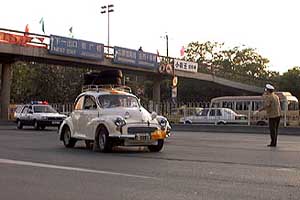 Police direct the classic cars through Beijing. Those who survive Nepal will face "Delhi belly" in India, risk encounters with bandits in Pakistan, and be forced to empty their medicinal whiskey before traversing Islamic Iran. They will tackle the tortuous Acropolis country of Thessalonika, Greece, take a brief ferry trip across the Aegean to Ancona, Italy, and twist around 48 hairpins in the Italian Alps. The final stretch will be a dash through Germany's Rhone Valley and down into France. The drivers will rely entirely on maps and guidebooks to navigate. Rally planners have provided route notes, which describe landmarks throughout each day. (In Tibet, the warnings include: "!!Road collapsed!!" "!!Sandslide!!" "!!Rocky section over landslide!!") However, organizer Young assured the navigators that the notes are not reliable and the route is likely to change. When the crews hissed and gasped in dismay, Young (think Willie Wonka) dismissed them with an imperious wave and explained that the 1907 winner, Prince Scipione Borghese, did not have the benefit of notes -- or even of roads: "Borghese had to keep the sun on one arm and hoped he would not miss Paris." As in 1907, a well-chilled magnum of Mumm's champagne will be on hand for the first car to reach the Eiffel Tower. But the rally is more endurance contest than sprint. Organizers are encouraging drivers to aim for silver medals, given to those who finish each day's rally stage. To qualify for a gold medal, crews must start and finish each day within an alloted time, and must have a relatively clean driving record when they reach Paris. Cars are divided into four categories: the vintageants, automobiles made before 1950; the classic cars, models manufactured between 1950 and 1968; the classic four-wheel drive vehicles; and touring cars, which include all crews that will be switching drivers or passengers along the route.
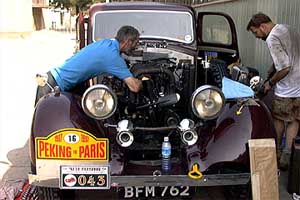 Jonathan Prior works on his 1936 Railton. Despite organizers' insistence that the goal of drivers should be merely to finish, teams have their eye on winning. Phil Surtees and John Bayliss spent the week scrutinizing the competition. And the Brits, who are driving a 1942 Ford Willys Jeep, believe that most of the other entrants are ill prepared. Drivers were instructed to increase the ground clearance on their cars because of the rut-filled, rock-strewn roads. They were also told to adjust their engines for the low octane "yak butter" gasoline of Asia. "My friend tells me that the Australians are well-prepared but the Americans are not," says Bayliss. However, he does allow for the sheer will of entrants. "Many of them are self-made men and have spent their lives overcoming tremendous obstacles. They may know how to dig in their heels." Midwestern telecommunications pioneer Donald "Too Tall" Jones thinks American ingenuity can give the Europeans a run for their money. A newcomer to auto rallying, Jones chose his 1954 Packard convertible because it was built for traveling long distances over rugged American terrain. He also feels the large, luxurious, cherry-red auto conveys his American identity. "The Packard was the cat's ass the '20s, '30s and '40s," he says.
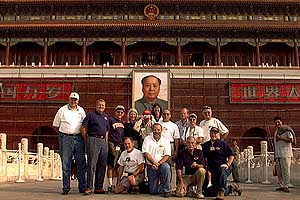 American competitors in front of the Gate of Heavenly Peace at Tiananmen Square. Herman "the German" Layher has the same affinity for eye-catching cars, and
explains that he's driving the 1907 La France because it is "Vild! Vild! Vild!"
And Herman shakes as he explains his impatience to put his "Funkenblitz" to the
test: "It's time to go, I want to drive, I want to drive, it's time to go!
Pictures (from top right): Brown Brothers | Popperfoto/Archive Photos | Auburn Museum/Archive Photos | Drew Fellman/Candide Media Works | Copyright © 1997 Discovery Communications, Inc. |