
|
High Jinks on the Friendship Highway By Chris McKenna Lhasa Prisoner Says "Life is Good Inside" -- China Daily, Sept. 2, 1997 NYALAM, Tibet, Sept. 22 -- We had known for several days that the Chinese border police were looking for our photographer, Drew Fellman, and our sound editor, Mike Bettison. Their crime: They were not on the official rally list. The prospect of their imminent arrest was unsettling, but we were reassured by recent news reports that life inside Tibetan prisons was quite jolly. We also believed that Drew and Mike would have no problems until they tried to cross the border. We were wrong. After spending the night at the base camp of Mount Everest (known here as Chomolanga, Goddess Mother of the Universe), we piled into a rented Land Rover. It would be our last full day in China/Tibet, culminating with a climb up the 16,400-foot La Lung-la Pass along the Friendship Highway to Nyalam, a town near the Tibet-Nepal border. Moments before we left, a white police car pulled up beside us. Several policemen hopped out and exchanged tense words with our anxious Chinese tour guide. They were looking for Drew and Mike. Peeking out the dark-tinted windows, we searched for an escape route but there was just the vast grassy plain. When the police moved to the outskirts of the campsite, we saw our opening and bolted on foot. I went one way. The "criminals" went another. At the far end of the campsite, I spied a rally support Land Rover, driven by Tony Fowkes, head of the service unit. Paramedic Sgt. Mark Thacke and mechanic-virologist Mike Leahy were also on board, but they agreed to let me squeeze in the back seat.
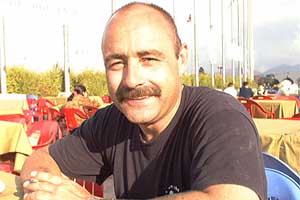 Sgt. Mark Thacke, the rally paramedic By nightfall, the support vehicle and its trio had pulled several cars out of a river, administered emergency treatment to an accident victim, narrowly escaped an angry group of locals, and hoisted a once-exquisite Aston Martin onto a truck packed with Tibetans and what appeared to be a sheep corpse. But let me back up. Not two minutes after leaving the campsite, the road was under water. While the water was relatively shallow, maybe two feet at its deepest, drivers who hesitated instead of plowing straight through the stream got stuck. Fowkes pulled several cars across the stream and towed a 1961 Rover out of the muck. We were preparing to leave when Brit Simon Mann came walking down the road, coated in dust. Mann's car and co-driver were a mile away: the drive shaft of his 1964 Aston Martin DB5 was severed. When we arrived at the scene, Mann's partner, Tony Buckingham, was sitting in his beach chair, Walkman on, sunbathing. Despite his nonchalance, the breakdown was a blow. The duo had entered the rally to win. Fixing the car would cost the team a day, and they would fall too far down in the rankings to ever make their way back to the top. We were driving with the Aston in tow when a message arrived on the Land Rover's satellite fax: "A competitor has been involved in an accident; report immediately to the first time check." It was the rally organizers' worst fears: A native had been hit by a Mercedes as he walked out from behind a truck and onto the road. A horrible incident, it was hardly surprising. In China crowds were tightly controlled by the police, who often closed roads until the rally had passed. The Tibetans were not similarly cowed. Desperation had made them bold and they dashed in front of the cars, palms up. Children with matted hair, clad in torn filthy rags, played chicken with the cars, waiting until the last possible moment before leaping away. We reached the injured Tibetan, a man in his 20s, at a crude clinic moments later. Rally doctor Greg Williams had already arrived, and had taken the victim from the scene and begun treating his injuries, a broken leg and a head wound. Thacke, an army medic with his blood type tattooed on his forearm, leapt out of the car with his bag and went to assist. The rally staff treated the man on the floor of a small room in the barren clinic, the door open to provide light.
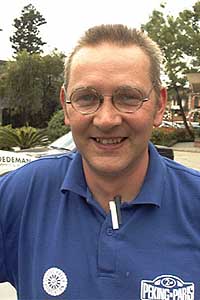 Dr. Greg Williams Outside, curious locals began pawing at the crew, begging. Soon they realized that Fowkes was the soft touch and inched ever closer as he brought out the kettle for a brew. Tea time ended abruptly when a soldier arrived and tried to arrest Dr. Williams, who was trying to leave after stabilizing the patient. The locals wanted the staff to drive the injured Tibetan to the hospital, but it was impossible to lay him flat in either of the support vehicles. This explanation did not satisfy the Tibetans, who were growing angrier by the minute. One man began pounding on the front of the Land Rover. "Pack up," Thacke urged Fowkes. "It just might be get-out-of-Dodge time soon." Fowkes was unfazed and when the local police arrived shortly after, he walked over and explained that the doctor had done all that he could and was leaving the patient in good condition. Whether the police actually understood Fowkes or simply wanted to get rid of us, we were soon on our way. A new message appeared on the satellite fax, a scolding from rally officials who had heard that we were still towing the Aston Martin. If the crew had followed the 10-minute rule, the Aston team would have been left near the camp site, left to its own devices to make it to a garage in Tingri, the nearest town. Instead, Fowkes convinced the driver of a passing truck filled with Tibetan passengers to carry Mann and Buckingham to the border. The price was cheap, $100, but the duo had to share the ride. After Mann maneuvered the Aston down a rocky slope and onto the back of the truck, the passengers displaced by the now-filthy car made themselves at home on top of it.
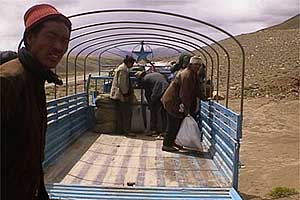 Tibetans clear out the truck to fit the crippled Aston Martin. "It's really good fun, isn't it?" asked Fowkes.
I, however, was not having fun. I had neither a tent nor a sleeping bag. Nor did
I have any idea whether Drew and Michael had made it safely across the border. Pictures (from top right): Brown Brothers | Popperfoto/Archive Photos | Auburn Museum/Archive Photos | Drew Fellman/Candide Media Works | Copyright © 1997 Discovery Communications, Inc. |