|
Latest featured classic: 1953 Citroen 2CV |

|
Under the Big Top By Chris McKenna & Robert Thomas TABRIZ, Iran, Oct. 8 -- It's 5 a.m., but Martin Clark and John Vipond are already on the road. These "clerks of the course" are constantly working, and right now they're focused on getting the drivers safely into Turkey. Despite a warm official welcome, many rallyists will be happy to leave Iran. The women, especially. In Iran women are required by Islamic law to conceal their bodies in public. The country makes no exception for foreign visitors, even those who are literally passing through. Women are supposed to cover everything but their face, hands and feet, and most Iranian women wear the traditional chador, a head-to-toe black cloth clasped beneath the chin. Most of the female motorists have stuck to the letter of this Islamic law, but played a bit loose with its spirit (wearing a tent for eight days can make even the most apolitical woman feel a tad subversive). The result is a kaleidoscope of eye-catching turquoises, scarlets, bright oranges, pinks and greens.
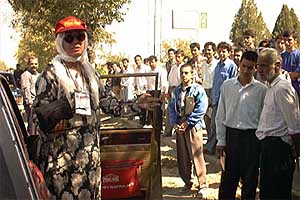 Women drivers such as Linda Dowell draw gawking crowds even when covered. "This country makes you feel so contrary. ... I'm about to explode," says driver Patricia Dalrymple. Pat seems to be covered from head to toe, but she's wearing bright red lipstick today and says she has no socks with her loafers. "Yes, I'm displaying a very finely turned ankle," she says. "Let's see if I can make it through the day without being arrested." Some of the women rallyists brought special curve-concealing apparel from home. Others prepared for Iran by spending hours in the bazaar in Lahore, Pakistan, looking for the appropriate shroud. The result has been a bizarre eight-day caravan through Iran: billowing Pakistani shawls, elaborate Indian saris, strawberry tie-dyed wraps, clashing plaid ensembles and leopard-spotted scarves.
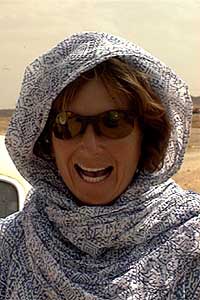 Francesca Sternberg found her Iran outfit in East London. But there was no way to make light of the other lingering image of Iran: sporadic attacks by stone-throwing youngsters. "It was bloody awful," says Martin Clark, an experienced rally organizer. "One guy even got out of his car and started chasing a kid through the streets." The rally lodged a formal complaint about the stone throwers with the Iranian vice president. Yesterday the effect of the added security was evident: "Complaints of stonings dropped from 30 or so the first day, to four or five yesterday," says John Vipond. Clark calls this "typical of the Third World. If you're on their good side, they'll shoot the peasants to get them out of the way."
 Some Iranian teens want merely to encourage the drivers. And the support crews have faced constant sniping from competitors, who complain about everything from road conditions to accommodations to fair play. After the accident in Pakistan that killed the father-and-son team of Josef and RenČ Feit, some drivers blamed the marshals, saying that terrible road conditions were made worse by poor planning and an unrealistic schedule. As the rally weaved through Iran, the bad mouthing continued. "Last night, a guy actually came up to me and asked if it was true that we'd reserved only 50 spots on the ferry from Greece," says Clark. "The rumor is that Philip [Young, the rally organizer] wants to strand half the field so he doesn't have to pass out as many medals. I told him I was bloody insulted!" The rally responded to the complaints by offering one-on-one grievance sessions with Young. "Only three people showed up, which shows you that we have a lot of people who are really good at talking behind our backs," Clark says. "They're tired," Clark says of the drivers. "They've been out here for weeks. Miss their families. Most of them know they can't win. They're fed up. But I think that will change when we get to Turkey."
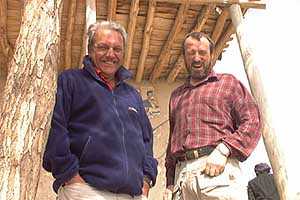 Rally marshalls John Vipond (left) and Martin Clark As we leave Tabriz before dawn en route to the border crossing at Bazargan, the drivers seem to be in good spirits. Under the moonless sky, we can see nothing but the road, glistening with our first rain since Tibet. Phil Surtees and John Baylis -- who have led the field since Lahore, Pakistan -- are exultant. "It's basically ours to lose now," says Surtees, cautious but confident. "We just have to be careful not to make a wrong turn." The optimism seems justified: Bad roads, open-air camping and risky meals are mostly behind us. And we will soon rid ourselves of headscarves and theocratic politics. This morning, our last in Iran, we are greeted by a massive white beacon shimmering in the diffuse light of the rising desert sun: snow-capped Mount Ararat. Turkey is 11 miles away. "Do you realize," says Vipond, "... tonight we'll drink beer and eat potatoes?"
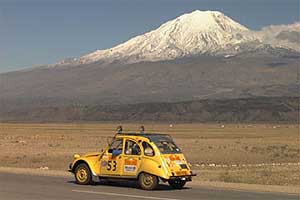 Mount Ararat
The Current Top Five
1. Phil Surtees/John Bayliss (Great Britain),
2. Ted Thomas/Vic Zannis (USA),
3. John Catt/Simon Catt (Great Britain),
4. Mohsen Eijadi/Ramin Khadem (Iran),
5. John Jung/Andy Vann (USA),
Pictures (from top right): Brown Brothers | Popperfoto/Archive Photos | Auburn Museum/Archive Photos | Drew Fellman/Candide Media Works Copyright © 1997 Discovery Communications, Inc. |